

Some of the links on this website are affiliate links. This means that I may receive a small payment if you click on them.
If you’re looking to take control of your money but have no idea where to start, here we have compiled the best financial books for beginners.
These books don’t require any prior financial knowledge. And you don’t need to understand financial jargon or be a budgeting pro.
They contain information to help you:
- Get a handle on your debt.
- Make plans for your future.
- Understand your money mindset.
- Take practical steps to improve your relationship with your finances.
And are a great starting point to help you be all round better with money.
Table of Contents
The Best Financial Books for Beginners
The Total Money Makeover by Dave Ramsey
 If you’ve heard of any of these books, it’s probably this one.
Though the man himself is a bit of a marmite character, the information contained in this book is really valuable.
Ramsey guides you through his step-by-step process of getting out of debt and building wealth using his ‘Baby Steps’ method.
BABY STEP 1 – Save $1,000 for your starter emergency fund.
BABY STEP 2 – Pay off all debt (except the house) using the debt snowball.
BABY STEP 3 – Save 3–6 months of expenses in a fully funded emergency fund.
BABY STEP 4 – Invest 15% of your household income in retirement.
BABY STEP 5 – Save for your children’s college fund.
BABY STEP 6 – Pay off your home early.
BABY STEP 7 – Build wealth and give.
from Ramsey Solutions
It definitely is debt-focused, so if you’re starting out with no debt (well done you!) then you may want to choose another book over this one.
Also, it obviously written for an american audience and as a result some parts don’t translate well to the UK (Step 5 for example) – so it’s not a book you’re going to read cover to cover and implement every piece of advice to the letter.
Another thing worth noting is that Ramsey is Christian so there’s a lot of religious reference in this book. However, that doesn’t mean that the practical advice isn’t worth taking onboard if you’re not religious.
And finally, his tone is very ‘tough love’ – so if you’re looking for a hand-holder, this book isn’t the one.
In summary, despite the somewhat negative caveats above, this book is definitely one of the best financial books for beginners.
It is thorough and offers lots of practical guidance which could really help you to take control of your money and start working towards financial independence.
Manage Your Money Like a F*cking Grown-Up by Sam Beckbessinger

If you like a straightforward, no nonsense tone and don’t mind a bit of swearing, this is the book for you.
A great option for people in their 20s/30s (female millennials will particularly get on with this book!), though one that can be appreciated by all ages, this book strips money back to basics and teaches you all the things you wish you’d learned about money in school.
If you’re worried about finance books being filled with jargon and written in a way that makes you think, ‘what the hell are they talking about?’ – this book definitely isn’t that.
It’s almost simplistic in places but teaches you about that stuff that does sound scary and complicated (diversification, compound-interest-what-now?) in a way that you will understand.
It has games and activities to get you to take action and is chock full of practical advice you can implement in your own life to see real results with your money.
If you’re looking for a gift for the young adult in your life, this is a great choice.
Money: A User’s Guide by Laura Whateley

Another book aimed at millennials (though the author herself says she uses that term reluctantly) but useful to anyone who might describe themselves as ‘financially illiterate’.
This is a guide that’s broken down into three main sections that you can easily dip in and out of if something isn’t relevant to you – you don’t need to read it cover to cover (though I’d recommend that you do!) to benefit from it.
- Part One – Whateley addresses the key areas of personal finance most relevant to her target audience such as ‘How to buy a home’, ‘How to budget’ and ‘Everything you need to know about pensions’
- Part Two – This section looks at the psychology surrounding money and how our emotions affect the way we deal with it. It also addresses money in relationships.
- Part Three – The final section focuses on ethical finance – so looking at your finances in a way that is mindful of its impact on the environment and other people.
It’s a real comprehensive overview of all things personal finance but is written in an informal, easy to digest manner which enables you to take action.
Grab a notebook, some highlighters and PostIts because you’re going to want to implement your learnings from this book.
I Will Teach You to be Rich by Ramit Sethi
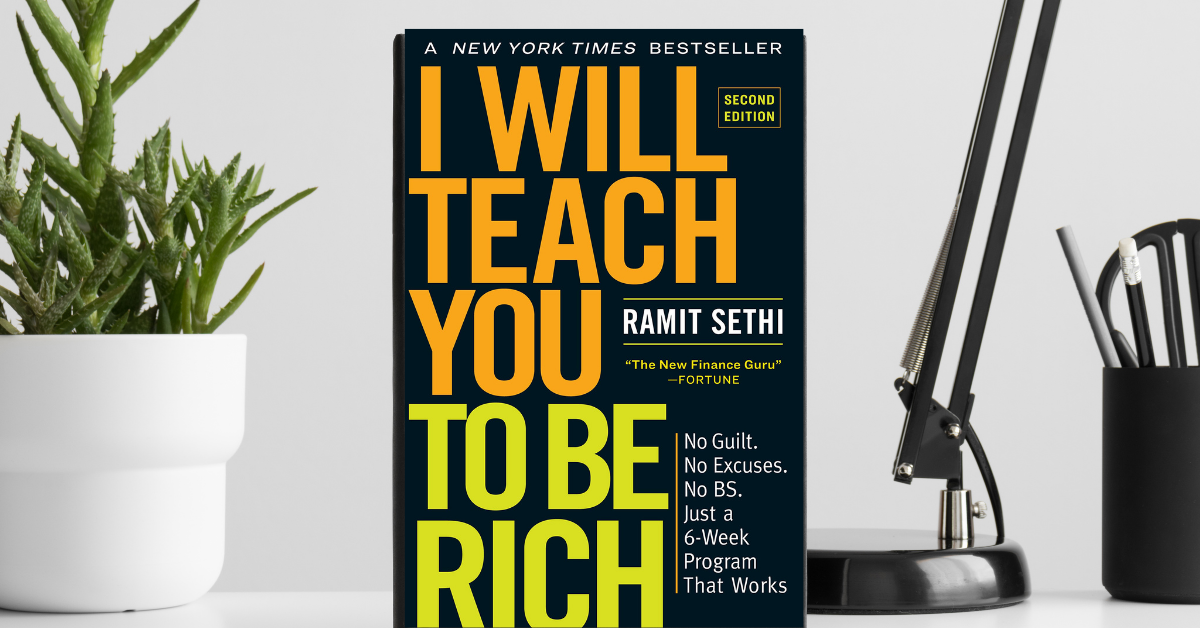
Another great, practical book, ‘I Will Teach You to be Rich’ is set out as a 6 week program, tackling 9 key areas of personal finance.
Though it is sold as a 6 week program, there’s no reason why you can’t take it at your own pace.
It does target younger readers and the writing style is a bit more affable than our friend Mr Ramsey.
It also has a less ‘money shaming’ kind of vibe to it – Sethi doesn’t try to guilt you into not spending ANY money and advocates for treating yourself but in a way that you can still build wealth.
The investing content is particularly good – there’s just something about his writing style that make it feel painless.
This book was originally written for an american audience though a UK edition was later released – so make sure you pick up the right one!.
Summary
The world of personal finance can be a minefield if you’re just starting out.
But hopefully, with a little help from any of the books mentioned above you’ll feel much more equipped to navigate it.
You might also find these articles useful:
- How to Budget Like a Pro
- Best Investing Apps UK for Beginner, Intermediate, and Experienced Investors
- Generational Wealth: what is it and how to build it
